
 In today’s episode, we talk about describing people instead of labeling them.
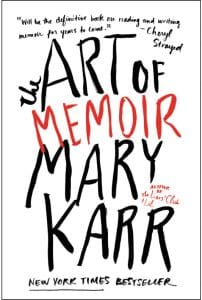
Mary Karr, a pioneer of modern memoir, offers great advice on this in The Art of Memoir and a Wall Street Journal interview.
If you have a subscription to the WSJ, you can read the “Teach, Memory” article here.
Karr shows us that labeling someone as a drunk is lazy and judgmental. Instead, we illustrate actions—like her pouring her mother’s vodka down the sink—that allow readers to draw their own conclusions.
Our first drafts might include labels, but revising to show actions strengthens the story. Our writing improves when we let readers be the judges.

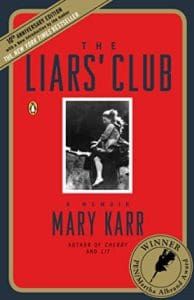
Watch episode #18 to learn more about Mary Karr’s first memoir, The Liars’ Club. It’s hard-hitting but incredibly well done.
But always remember, whether you label or describe, which I hope you’ll work on, the only way to do this wrong is to not do it at all!
There are still two open spots for writers on the Writing the Waves cruise.
Check out the cruise page for all the details.
My husband, Bill, and I loaded the truck with fishing gear and canoe on the first Saturday in May. We drove one hundred miles west into the foothills of the Rocky Mountains to Cow Lake. As we approached the lake, I looked over at Bill as he stared at the snow-covered frozen water. Here we were, canoe on top of the truck, sitting in the parking lot with nowhere to launch our canoe. It was too late for ice fishing and too early to fish by boat. “Do you want to go for a walk?” I asked. “No, let’s go… Read more »
When my mom and I got back to Dorothy’s shack, her husband, an old man named Carl, glanced in my direction. He mumbled to himself, “Waits a minute. What do me eyes see? I gots to clean me spectacles. He coughed like an old grandpa bullfrog. I jumped. He took off his glasses, rubbed his eyes, and cleared his throat again. He burst out like a cat hacking up a fur ball. My eyes opened bigger, and I winced. Carl reached into the bib pocket of his overalls and pulled out a dirty, tattered, brown-stained handkerchief, and polished his glasses with… Read more »
Labeling is too much like telling rather than showing. It’s a shortcut. If I wanted to be explicit about it, I would put the label in another character’s dialogue, which would give the reader information about both characters. Here’s my entry:
Her lips pinched as she looked at the clutter on the coffee table, and I saw her run a surreptitious fingertip over the desktop. I was tempted to hand her a rag and a can of Pledge.
I’d like to add another one.
While we were talking at the restuarant, he kept glancing at his jacket on the coat rack, making sure it was still there even though it’s been twenty years since he’d lived in his old neighborhood.
This is mine.
I shared with a girlfriend I hadn’t seen for awhile a humorous story from Zits, a comic strip about a teenager and his romantic attempts that was so far exaggerated, yet true. She looked at me, her lips pulled tight and eyes staring at me without understanding. Gone was that bright, mischievious look she used to have.
I’ll give it a try:
Her eyes did not meet mine as I approached. Her usual sparkle and smile were replaced by sagging, ashen cheeks. Her lips parted but only breathing rushed between them.
This is a great episode. Description is so much better than a label because it gives the writer more control over the image. Readers may harbor many images of an alcoholic, but pouring out a bottle evokes one image.
My contribution:
Time had bent him, and he was as crooked as the road he now walked.
Good one, Dave!